Friday, December 14, 2012

Cleaning Up the Seams

Things have been a little slow in the boatshop these past couple weeks. After working hard to get the planking finished, I had to devote some energy to catching up in other areas of my life. Visits from out-of-town guests and Thanksgiving holiday activities filled my schedule. I also have a day job that requires me to do, you know... work.

...And... we signed on a new crew member. He made his mark on November 26, with a rating of "Ship's Baby." This has, among other things, thrown off our normal schedule of watch keeping.

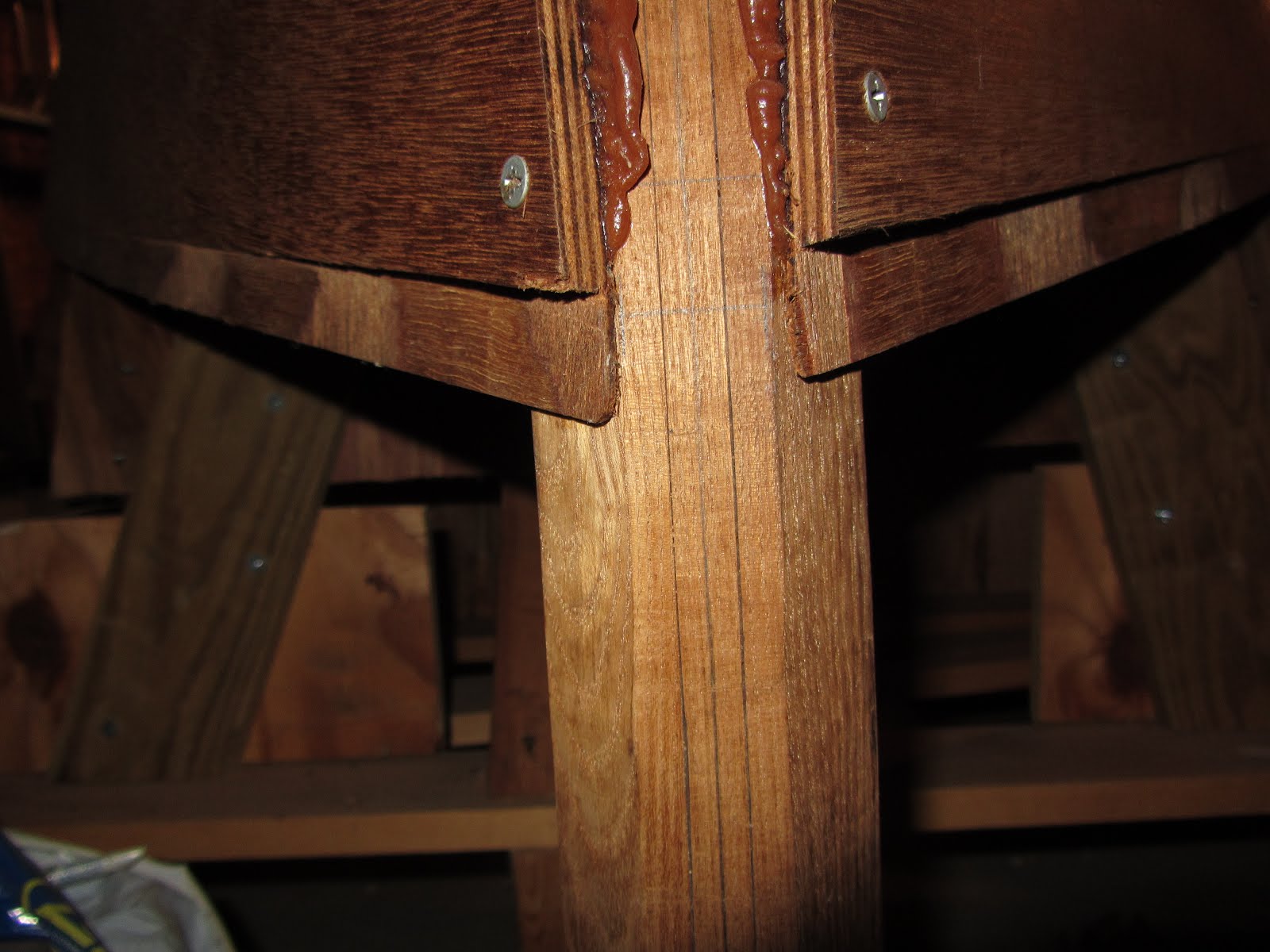
I've been getting back to work in the shop, though, and cleaning up the glue seams at the plank lands. I was not diligent about taking care of this as I went along, and so now I have a job before me. I cleaned up one seam with a chisel, spreading the work over a couple nights. It went well enough, but was tiring for my fingers and wrists.

Tonight, I had the thought of using my rebate plane. I took off all the guides and cutters, so the plane blade can cut cleanly into a right angle corner. I finished a second seam without difficulty. Some areas need more attention than others, and I'm still trying to get the hang of it, but my basic approach is this: (1) clean up the bottom edge of the upper plank, which is facing up, since the boat is upside down, (2) use the edge of the plank as a guide for the plane while working away at the squeeze-out, (3) gradually change the angle of the plane until the blade is parallel with the lower plank. Moving along in this way, the job goes pretty quickly.

I'll try to get some photos after I work on this technique a bit more. I've done two of twelve seams. I should be an expert just about the time I finish.

Monday, November 26, 2012

Hanging the Sheer Strakes

With the planks glued up to full length, it is very nearly time to glue them to the boat. There are just a few things that need to be tended to first.

First, the plank lands have to be shaped. There is very little angle between the sixth strake and the sheer, so not much has to come off, but it needs to be done. I do this with my power plane; you can see the setup here. I clamp a batten to the moulds, along the sheer. A length of threaded rod is tightened in the hole for a guide rod. The end of the threaded rod has a short length of 1 1/4" dowel with a hole drilled through it's center. The hole is just the right diameter that if the plane and batten are set on a flat surface, the dowel will ride snugly on the batten. Thus, the bottom surface of the batten and the cutting surface of the power plane are in the same plane.

It works all right. The position of the rod needs to be adjusted as you go, and it takes some effort to work around the clamps, but it's not too bad. Of course, I always control the plane with two hands. This photo is staged, with one hand holding the camera, and the power plane unplugged. The biggest temptation is to try to take off too much wood too fast. Take it easy, and work carefully, especially on the shallow angle of this last strake. Do I take my own advice? No. But epoxy can hide a lot of things...

When I worked on the planking up to this point, I made every effort to keep the two sides of the boat symmetric. Nonetheless, errors crept in, and more on one side than the other.

Here you can see the stem, with the planking on the port side about 3/8" lower than the starboard. I had hoped that errors on one side would be balanced out by errors on the other, but it didn't turn out that way. Since the sheer strake has to exactly match the sheer line at the stem and frames, there is no room for slop on this plank.

Here you can see a test fit of the port side plank at the stern. Like the bow, it is a little lower than the starboard side. So the port side plank needs to be reshaped a bit to fit into the gains cut into the sixth plank at the stem and stern. Of course the plank has to be reshaped quite a bit along it's length to keep a fair curve. I marked the new edge at the end of the plank, and then used a batten to make a fair curve into the edge of the plank about 5' or so in from the end. This was cut out with a saw, and then brought down to the line with a hand plane. After a few test fits, and checking the curve by eye, everything fit into place. This all had to be repeated at the bow.

Next, it is time to cut the gains in the sheer strake. The purpose of these gains is so that the overlapping planking at the bow and stern will lie flat, in line with the stem and stern posts. It is possible to cut these on only one of the two planks but I didn't like the idea of trying to clamp the planks in place without damaging a feather edge on one of them. There is a lot of twist in the first few planks, and a lot of that pressure is on the edges. I've made a practice of cutting the gain through five layers of the plywood on the lower (earlier) plank, and then through two layers on the upper (later) plank before it is glued in place. This seems to have worked pretty well. Here you can see that I cut the gains with my Record rebate plane.

These things having been done, it is finally time to glue the planks to the hull. This always takes much longer than it seems like it ought to. It helps to have everything laid out in place and ready for quick application. The real problem isn't the time it takes to clamp things in place, though. The problem is that it takes an awful long time to (1) coat the edge of the plank to be attached with unthickened epoxy, (2) coat the plank land on the hull with unthickened epoxy, and (3) get a good layer of thickened epoxy on the plank land.

I begin by doing a dry fit, clamping everything in place, and making sure that the plank is lined up just where I want it. Then I drill a pilot holes for three screws to hold the plank to the stem post and three at the stern as well. These screws are temporary, and will be removed after the epoxy sets. Then I make some register marks - lines on the edge of the plank that continue onto the hull. Once everything is epoxied, matching these lines ensures the plank is in the correct position, or very nearly. Driving in the screws ensures it is just where I had it for the dry fit.

I usually begin with a coat of unthickened epoxy on the plank land. I brush it on with a disposable foam brush. It goes on more easily if the epoxy is warmer, but then it kicks off faster, too. I use System Three's "ketchup dispensers" to measure my epoxy. One squirt of epoxy and a half squirt (they have a little clip that limits the dispenser to a half-squirt) of hardener is plenty to coat both the plank land and the edge of the plank. But you have to work quickly, or it will start to gel before you are done.

Then I mix up a batch of thickened epoxy. I have a big tub of wood flour from System Three. I find the perfect measuring tool is the scoop that comes with powdered baby formula. For a squirt-of-epoxy-and-half-squirt-of-thickener mixture, one of these scoops of wood flour makes a slightly-runnier-then-honey mixture, two and a little bit will make a thicker mixture that won't run, even on a vertical surface. It takes several batches to cover the whole length of the boat, but I mix them one at a time. The epoxy cures more slowly spread out on the boat than in the mixing bowl. Invariably I end up needing just a little bit more, and end up wasting most of a batch. Oh, well.

Then it is time to bring the plank to the boat and get things lined up as best I can. First I get it "close" and attach on C-clamp near the center, at the 5th or 6th station. Then I get the edge lined up correctly and attach another clamp. Then I work my way along, attaching a C-clamp at each station mould, checking the alignment as I go. I screw a small block to the mould to give the clamp something to hold on to.

Then I screw the plank to the stem and stern posts, check the alignment again, and begin clamping the joint using plywood clamps and wedges. Finally I check the alignment once more, and go get something to eat.

Tuesday, November 13, 2012

Gluing the Scarfs

Well, this

is where I left things in the previous construction post. From the start of construction, I had planned to paint the hull. Consequently I had not been concerned with matching the grain or color of the planking stock.

Interestingly, the "meranti" plywood I'm using seems to alternate between layers of lighter and darker wood. The lighter wood seems a little less dense than the darker - almost like the ocume plywood I used to build a kayak, once upon a time. Most sheets have the darker wood on the outer face, but some have the lighter. You can see the difference in the pictures that show the hull. The color of the darker plies can vary considerably, too, even on opposite faces of the same sheet.

Well, the thought had come to me that I might like to leave the sheer strake finished bright, while painting the rest of the hull. I very carefully chose plywood that had face veneers with matching color, at least on one side. Unfortunately, though, when I traced the patterns for each section of the plank, I didn't pay attention to which side was up. Once I cut out the sections, there was no way to line them up so the colors matched correctly. Oh, well. Paint it is.

Now you may have seen in the post about my scarfing jig how I cut the scarfs to join the four parts of each plank together. So, the scarfs having been cut, it is time to start gluing the planks to full length.

If you look in the lower right of this picture

you can see a pencil line on the edge of the plywood. This marks the center of the scarf, and, when gluing up, aligning these pencil marks makes sure the plank will fit properly on the boat.

The process is pretty straight forward. First, I coat each face of the scarf with unthickened epoxy. Then I add wood flour to the remaining epoxy until it is about the consistency of honey or molasses. One face of the scarf gets a coating of this thickened epoxy and then the scarf is lined up...

...and clamped into place. The small silver clamps keep everything aligned, while the larger C-clamps put pressure on the joint. Wax paper between the joint and the scrap wood keeps the whole assembly from sticking together, and also leaves a fairly smooth surface that requires only a little cleaning up. First I use the small clamps to hold one side of the joint against a board underneath (with the scarf face up). After applying the epoxy, the other side is lined up, and clamped to the same board, holding the joint steady. Then the larger clamps are added, squeezing the joint between two pieces of scrap large enough to cover the area of the joint.

That's the theory, anyway. It's worked beautifully for the first 40 or so joints. Halfway through this final plank, though, something went amiss. I don't know if my pencil line was off, or if the setup slipped while I was gluing it up, but when I checked the next-to-last scarf to see how they fit, they didn't. Aligning the section of the plank with frames 3, 4, and 5 put things out of alignment by a couple inches at the bow. No way to finesse that!

So I cut one end of the joint off, shaped another plank-piece using the same pattern as before. (Is there a term for the sections of plywood that are glued up to make the full length plank? It seems like there ought to be.) Recut the scarfs. (It was sort of interesting to cut down to the glue line in the old piece.)

I didn't want to make the same mistake again, so I decided to glue the last four scarfs on the boat, like everybody else does. It wasn't as bad as I feared. It required a little more clamping ingenuity, and a little more effort to clean up the squeeze-out. All in all, though, not too bad. The full length planks seem to have a slight kink around the joint that I had to cut apart, but on the boat it looks pretty fair. I may have to adjust the sheer a little after I turn the boat over. Oh, well. I'm building a boat to use, not a museum piece, right?

Saturday, November 3, 2012

Field Trip: The Nina and Pinta

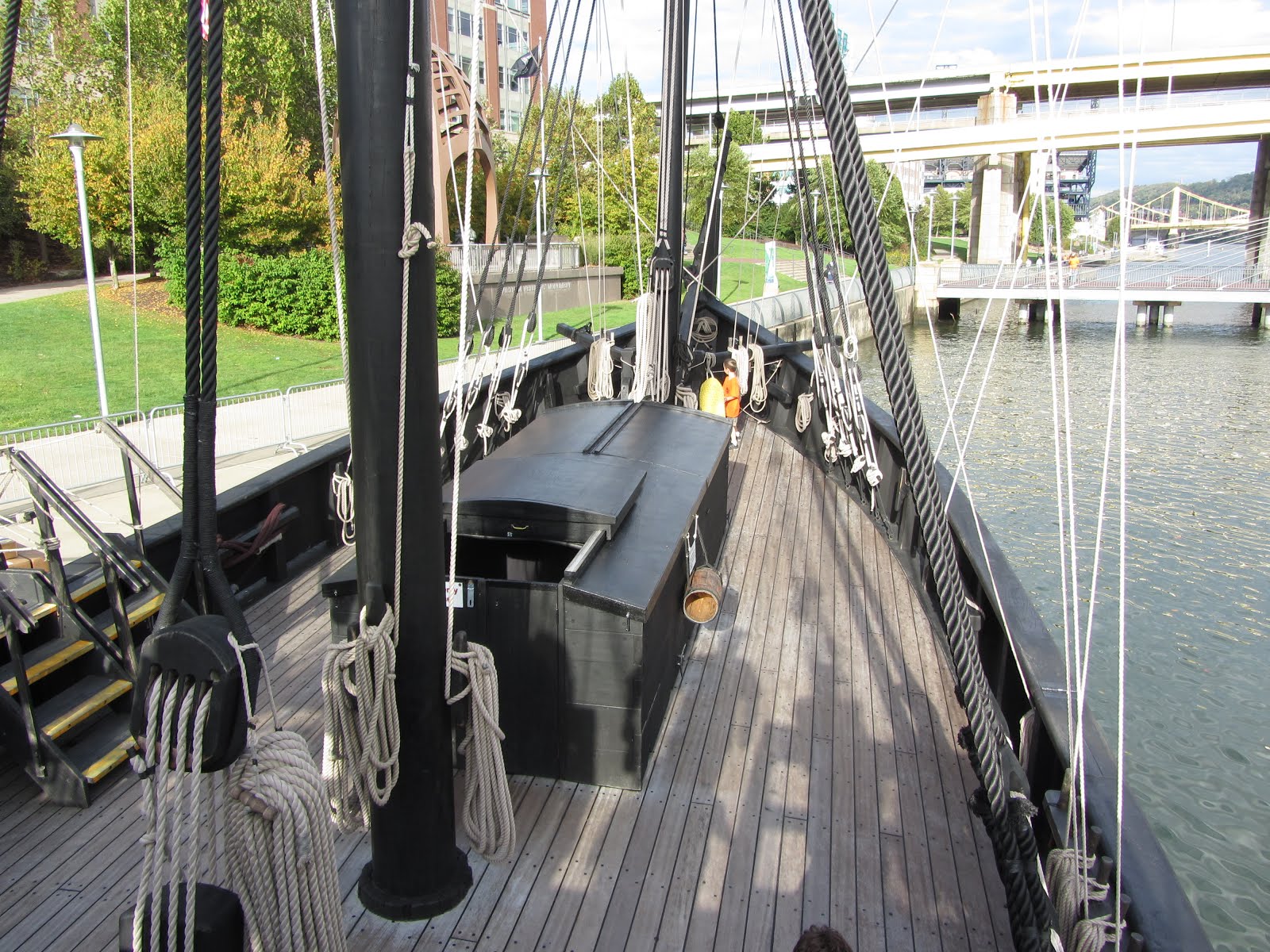
I had hoped to have the sheer strakes ready for installation by now. Well... that didn't quite happen. But that's a story for another day. For now, I thought I just show you some pictures of a couple incredible replicas of Columbus' Nina and Pinta. These ships travel around the country, spending a few days in each port. Maybe they are coming to a city near you!

Monday, October 15, 2012

Scarfing Jig

I built this jig to help me make consistent 12 to 1 scarfs for my planking. I made an extra wide base for my router from scrap 9mm plywood leftover from the planking stock. The base is stiffened by two 1/2 inch wide strips set on edge. The base is set into rabbits in the edge strips and glued. Some brads hold things in place while the glue sets. The base of the jig is made from 3/4 inch plywood, leftover from making the building frames. The rails are cut from 2-by stock, cut to a 12-to-1 slope on the band saw and cleaned up with a plane. The rails are screwed through the base into 2-by-fours set on edge. The screws are deeply countersunk, so the base of the router can ride on the sloped rails. In addition to giving a secure base for the screws, the 2-by-fours hold the base off of the workbench, leaving room to fit a clamp under the plywood.

Here is what it looks like when it's set up. You can see the pencil line 4 1/2" from the end of the plank that marks the start of the scarf. Some scraps of wood are stacked on the plank to raise a short 2-by-four high enough to clear the rails. This cross piece is clamped to the base, holding the plank in place.

The pencil line on the plank marking the start of the scarf is aligned with a line on the jig. This ensures the scarf is aligned correctly with the jig.

I cut the scarf with a few passes of the router, increasing the depth gradually to creep up on the line. I find that if I just take out the pencil line, and bring the front edge down to a feather edge, just a little ragged, the joint is pretty easy to clean up after gluing.

It's not a perfect setup. If the plank doesn't want to lie flat or has some twist in it, the scarf may not be perfectly even, or the cut may be too deep at the feather edge. In practice, it works pretty well, though.

I really was only think of the planking when I made this jig, but it might also be useful in a few other situations. I might find that I want to scarf material together for the sheer clamps, or when I start building spars.

Saturday, October 13, 2012

Shaping the Final Plank

Here is where we left things in the last construction post:

The patterns for the sheer strake had been cut out and shaped. Now it is time to get out the marine plywood. This seems like a big step, a momentous occasion. I'm really working on my boat again. When people ask me "How is the boat coming along?" I no longer have hang my head and admit that it is not coming along at all. I can look them straight in the eye and say "I'm working on the sheer strake. After that it's the stem and stern posts and the keel. Pretty soon, I'll be turning it over!"

Well, maybe I shouldn't get ahead of myself.

I traced out the patterns onto the plywood. After that I cut them out with my jig saw. I know that lots of people say that the jig saw won't cut a straight line, that it wants to wander. It's certainly true that I can't follow a line as closely with the jig saw as I can with my band saw, but it seems more like my fault than the saw's. It goes where I direct it, it's just harder to direct than the band saw. In any case, I saw about 5-10mm away from the pencil line. The fibers of the top ply tend to chip out, especially when cutting across the grain.

Here we see an "action shot" of my jig saw. I don't know how old it is, but it was my grandfather's before it was mine, and it is a heavy duty piece of machinery. No plastic body on this one! It runs fine, though it gets a bit hot when I run it for a long time, and it takes a while to cut out these planks. In the end, I use the jig saw to separate the planks from each other, and cut close to the line using the band saw. I didn't happen to get any pictures of that, but it you imagine someone using a band saw... that's pretty much what it looks like.

Finally, I used my router to trim the planks to the exact size of the pattern. The natural thing would be to use a template bit to do this. I don't happen to have one of those. I do have a flush trim bit, though. It's basically the same thing, but with the bearing on the bottom instead of the top. It's not quite long enough to cut both planks (port and starboard) at the same time. Oh, well. I like doing this, right? I get to do twice as much. In the end, I have two planks that exactly match each of the four patterns.

Next step... Cut the scarfs and glue the planks up to their full length.

Tuesday, October 9, 2012

Epoxy Test Pieces

When I began my boat building project, twelve years ago, I ordered two gallons of epoxy and two gallons of hardener from System Three Resins. I figured that would be enough to get me trough coating the hull.

In response to the question "What is the shelf life of your epoxy resin products?" The System Three product FAQ has this to say:

All solvent-free epoxies have essentially unlimited shelf lives so long as they are stored in sealed containers. The resin may crystallize or the hardener may darken but this does not affect its performance. If the material is more than a year old do a test to satisfy yourself that it cures properly.

Twelve being more than one, I did just that. I mixed up some epoxy and glued up some test pieces. I mixed a batch of straight epoxy, and a second batch to which I added wood flour (basically sanding dust, much finer than saw dust) until it had the consistency of honey. (The consistency of epoxy mixed in this way is measured on a scale from honey, through molasses, and all the way to peanut butter.) I glued up two test pieces, one of solid wood (pine), and one of the meranti marine plywood I'm using for the planking. In each case, both sides of the joint got a coat of the unthickened epoxy. Then I coated one side with the thickened epoxy and joined the pieces, clamping until there was some squeeze out all around the joint.

A couple days later (it was a little chilly, I wanted to give the epoxy all the time it needed to cure) the epoxy left in the mixing bowls had cured as expected. After some encouragement, I was able to pop out two epoxy disks.

The foam brush and tongue depressor are, of course, permanently embedded in the epoxy. You can see the tip of a tongue depressor in the disk of unthickened epoxy. It wasn't strong enough to break the bond of the epoxy with the plastic bowl. There was a small patch of uncured epoxy - just a thin film less than a square centimeter - left behind in the bowl of unthickened epoxy. I assume it was not completely mixed.

But what about those joints? How strong were they? I rigged up a destructive test using my face vise and a pipe clamp. The picture below was taken just after I heard the first "crack" from the joint.

Not long after that, the piece broke, but you can see that the plywood separated between the plies, not at the glue line.

In the second picture, you can see that the joint in the pine also split along the grain, not at the glue line. I rate this test a success! That's good, because I still have about $200 worth of this stuff. I'd hate to have to replace it, but even worse, how would I throw away three gallons of epoxy and hardener that wouldn't cure? It's hard enough getting rid of old paint. It's good to be able to file this under "Problems I Don't Have to Solve."